



POLICY EXPRESS · PE-DEVB-144 · Development Bureau
Urban Renewal and Old-Building Redevelopment
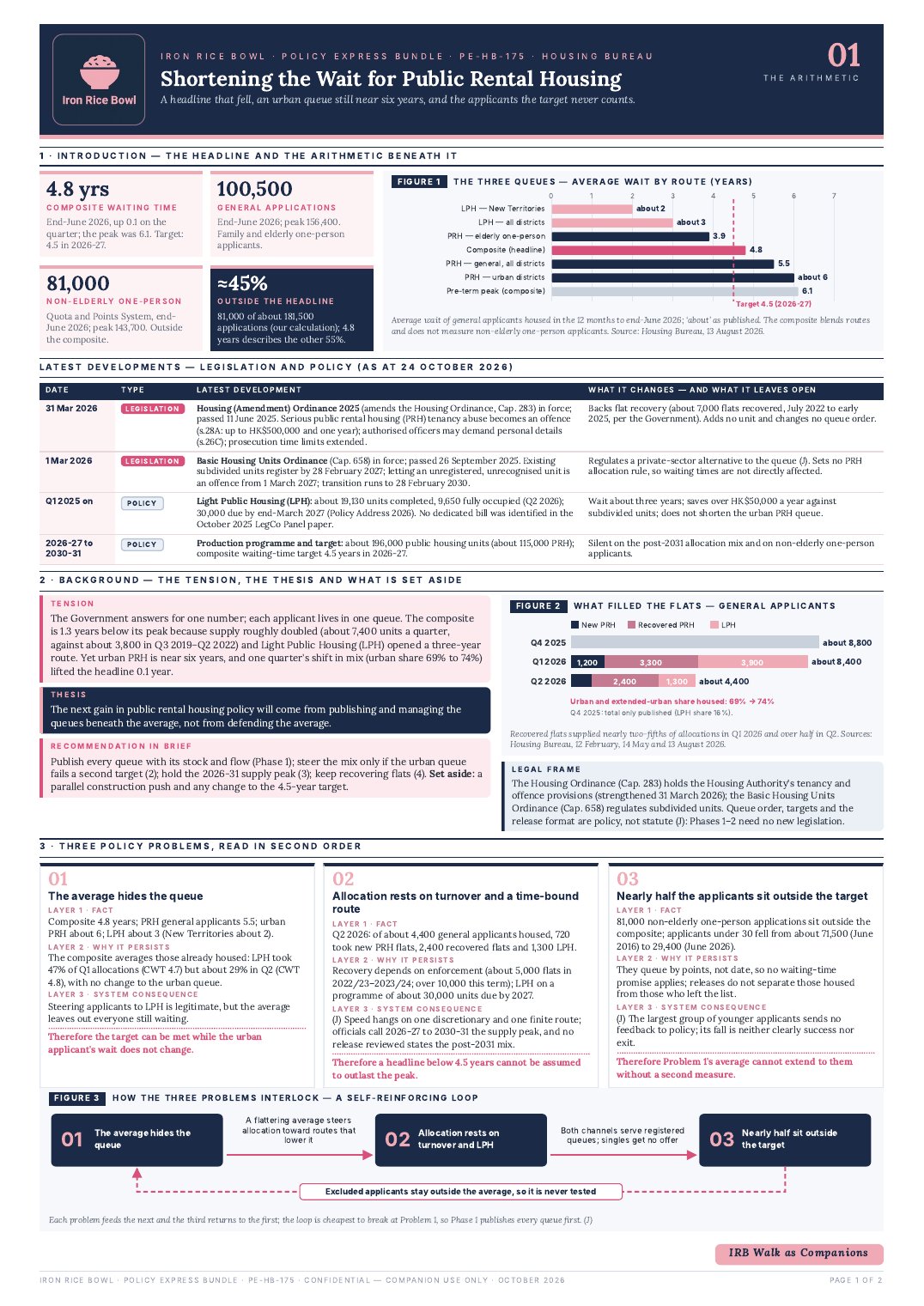
Old buildings are added three times faster than they are redeveloped, while the renewal authority runs deficits.
Free. We only need your email. Unsubscribe at any time.
2 pages · English and 繁體中文 · Built on the 1134211 Framework · Facts as at 25 October 2026
Included in the Sprint Pass
This brief is part of the 186-brief library. Page 1 is shown free for five featured briefs only.
See the format in five free samples
The tension and our thesis
The tension
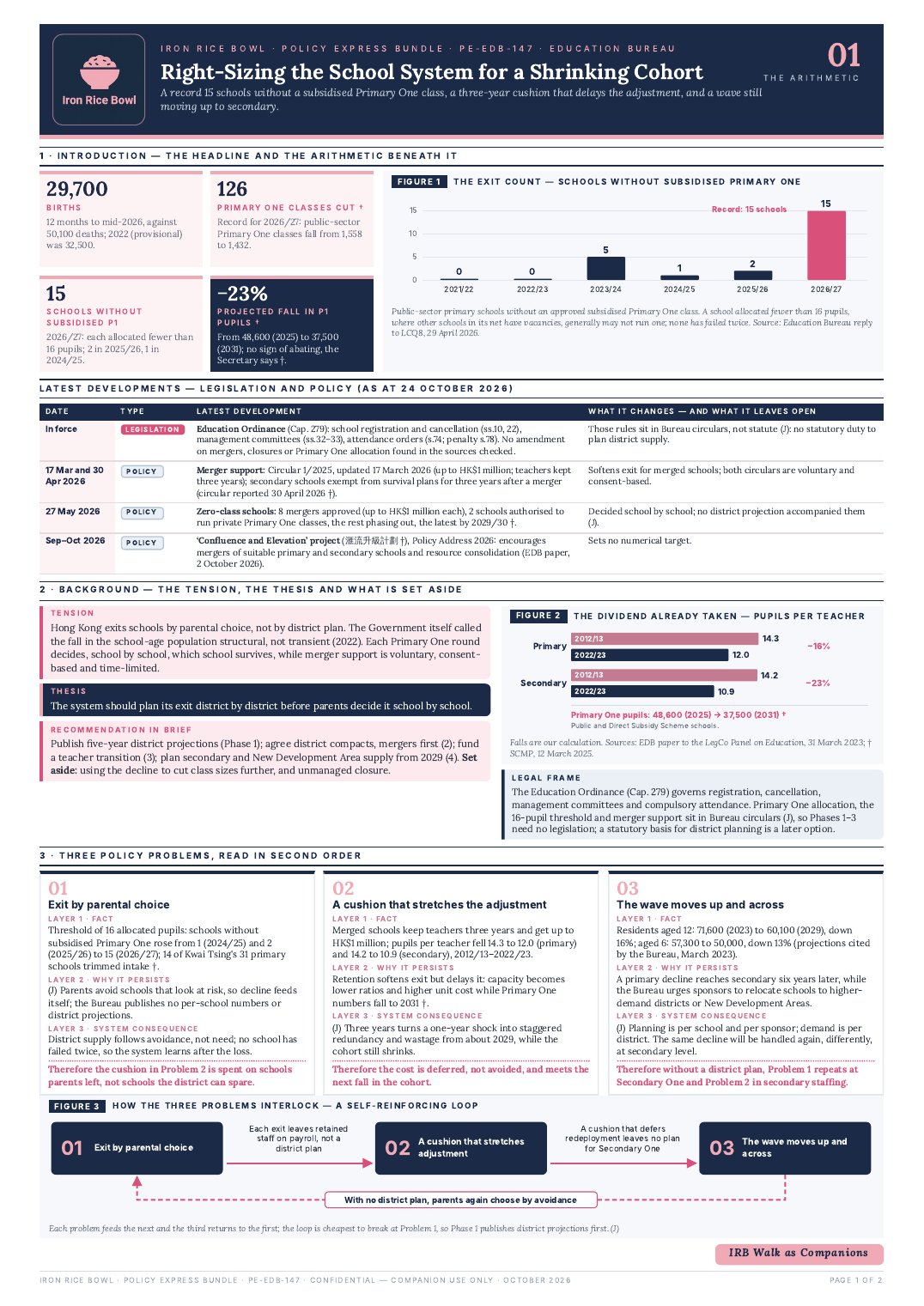
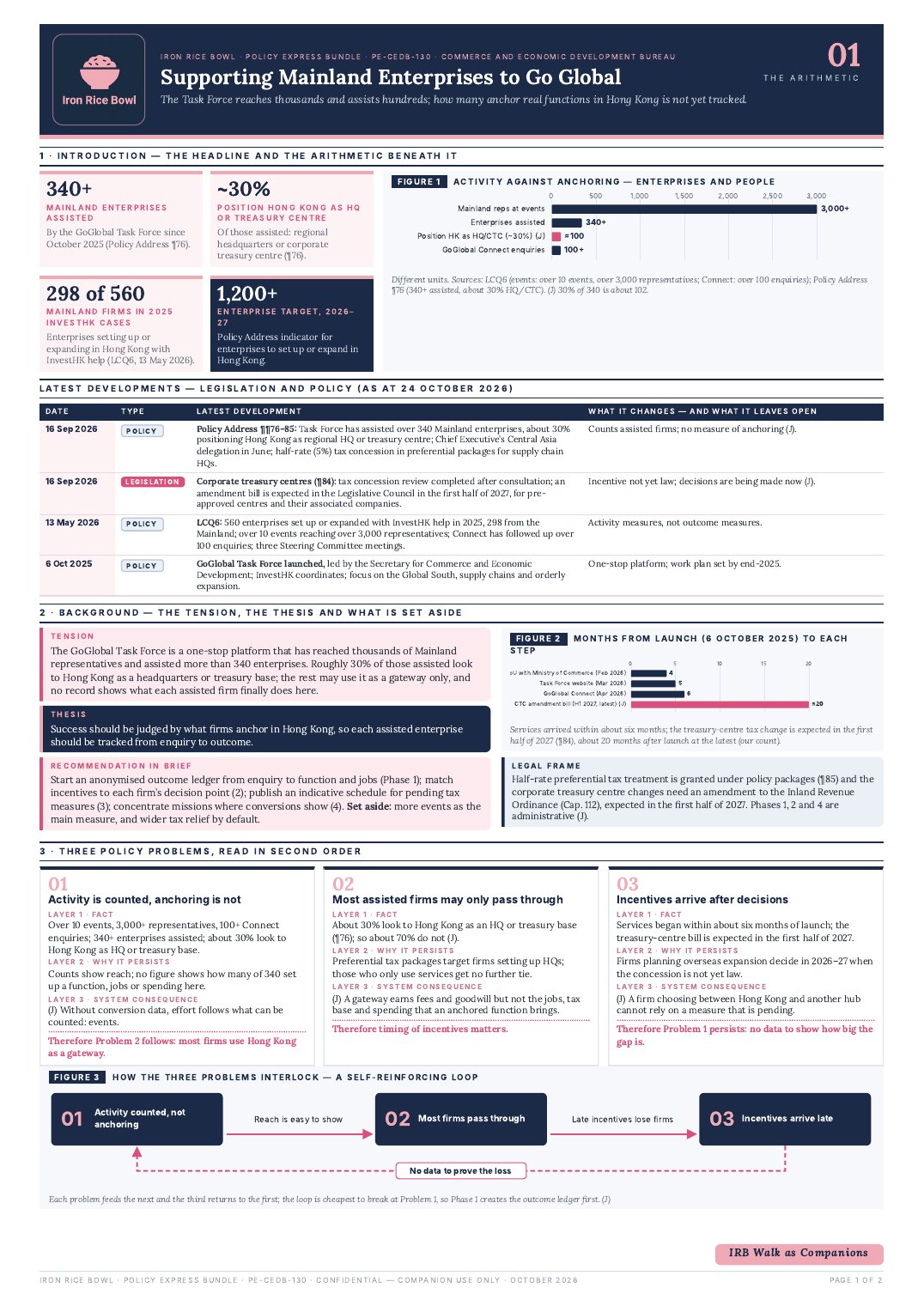
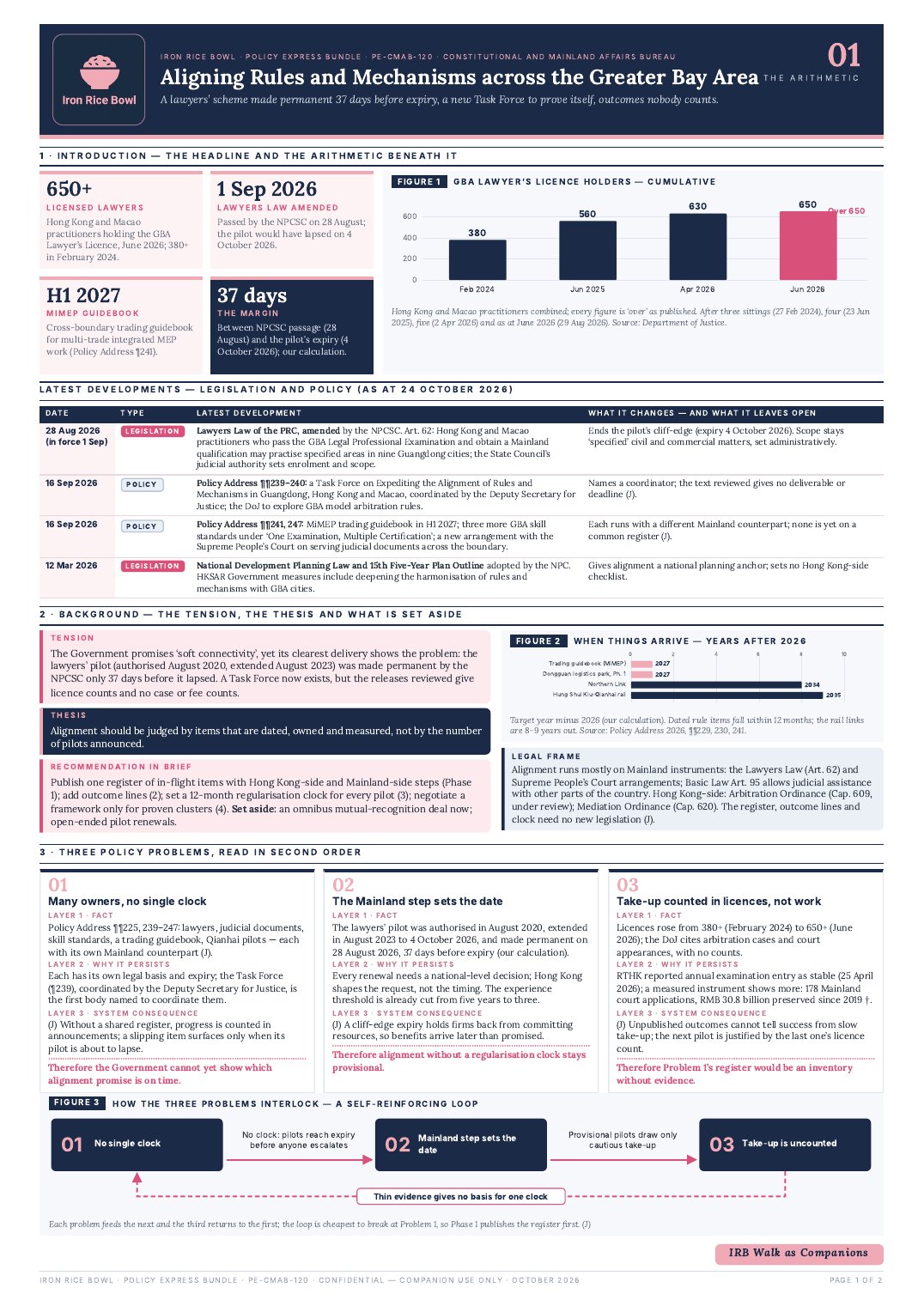
The Government is widening plot-ratio incentives and reviewing how the Urban Renewal Authority buys and compensates. But old buildings pile up, the Authority’s cash is thin, and owners have few convincing alternatives to the Seven-year Rule.
Our thesis
Renewal speed depends on who can afford to redevelop and why owners agree; the incentives, the Authority’s finances and owners’ offers must be tracked together.
Three policy problems this brief examines
- 01Ageing outpaces renewal
- 02The Authority cannot carry the gap
- 03Owners lack a convincing alternative
Each problem is developed in three layers: the fact, why it persists, and the consequence for the system.
Three options compared
A · Incentives first: plot-ratio transfer, bonus plot ratio, lower sale thresholds.
B · Authority-led: more funds, a higher borrowing limit and more sites.
C · Compensation first: Flat-for-Flat and Seven-year Rule reform.
The scored comparison, the justified recommendation with its phased measures, the implementation challenges, the stakeholder assessment and the success metrics are in the full brief.
Page 1 of this brief is not offered as a free sample.
See what is in the full briefWhat the Sprint Pass opens for this brief
Both pages, in English and Traditional Chinese: the introduction and background, key figures, the three policy problems, the scored options, the recommendation with its phased measures, the implementation challenges, the stakeholder assessment and the conclusion.
How Companions use it
Learn the structure.
Every brief follows the same 1134211 Framework, so you can rehearse the same shape of answer on any topic.
Borrow the facts.
The key figures and the latest developments are laid out so you can cite them with confidence and check them before you do.
Test your own view.
Form your recommendation first, then compare it with ours.
Briefs support your preparation. They do not guarantee any examination or interview result.
Facts and figures are checked against primary sources where we could retrieve them. † marks press-only figures. (J) marks IRB judgements. Facts as at 25 Oct 2026.
Questions
Preparing for 5 December 2026? Get all 186 briefs with the Sprint Pass.
See the Sprint PassIron Rice Bowl is an independent coaching provider. It is not part of, endorsed by or affiliated with the Hong Kong SAR Government. Briefs are study aids; facts are as at the date shown and should be checked against the latest official source before use.