


Mocker Assessment. Set A.
Twenty-five quality JRE assessment questions on the public policy matters of 2026.
Each one set to the standard of the paper, with the IRB Writing Skeleton and the Threshold Exemplars beside it. One-off, HK$4,880. The offer opens at 10:00 on 1 October and it will not wait.

Four tiers. Pick yours.
Enter the one you qualify for at checkout. Be honest about it.
The paper does not fail you for ignorance. It fails you for want of practice.
Most candidates sit the JRE without ever having read a single threshold-quality script. They know the policies. They have read the news. But the first full script they see at standard is the one they are expected to write in three hours, in the hall, at the moment it counts.
Practice papers exist. Few are set to the standard of the examination. Fewer still arrive with the skeleton that shows how the answer was built — and without the skeleton, a model answer is only a thing to admire, not a thing to learn from.
You cannot learn to write the paper the way you learn the news. You learn it the way you learn anything worth doing — by doing it, against a standard, before the day it counts.
Three instruments. One examination room.
Twenty-five full questions on the public policy matters of 2026 — set to the standard, calibrated to the paper, each one a three-hour rehearsal.
The house method for building a defensible script under time. From dissecting the question to the synthesised close — the same skeleton, every question.
Exemplars on the Introduction and the Conclusion only. They set you on track. The body is yours to write.
What the paper asks about. Not what it asks.
The topics are the map. The questions are the territory, and they stay in the paper. One of them is opened in full below.
| MA-01 | Long-term care architecture for an ageing population |
| MA-02 | Platform workers and the gig economy welfare gap |
| MA-03 | Primary healthcare reform and district health centres |
| MA-04 | Housing supply and the Northern Metropolis |
| MA-05 | Subdivided flats and the Simple Housing regime |
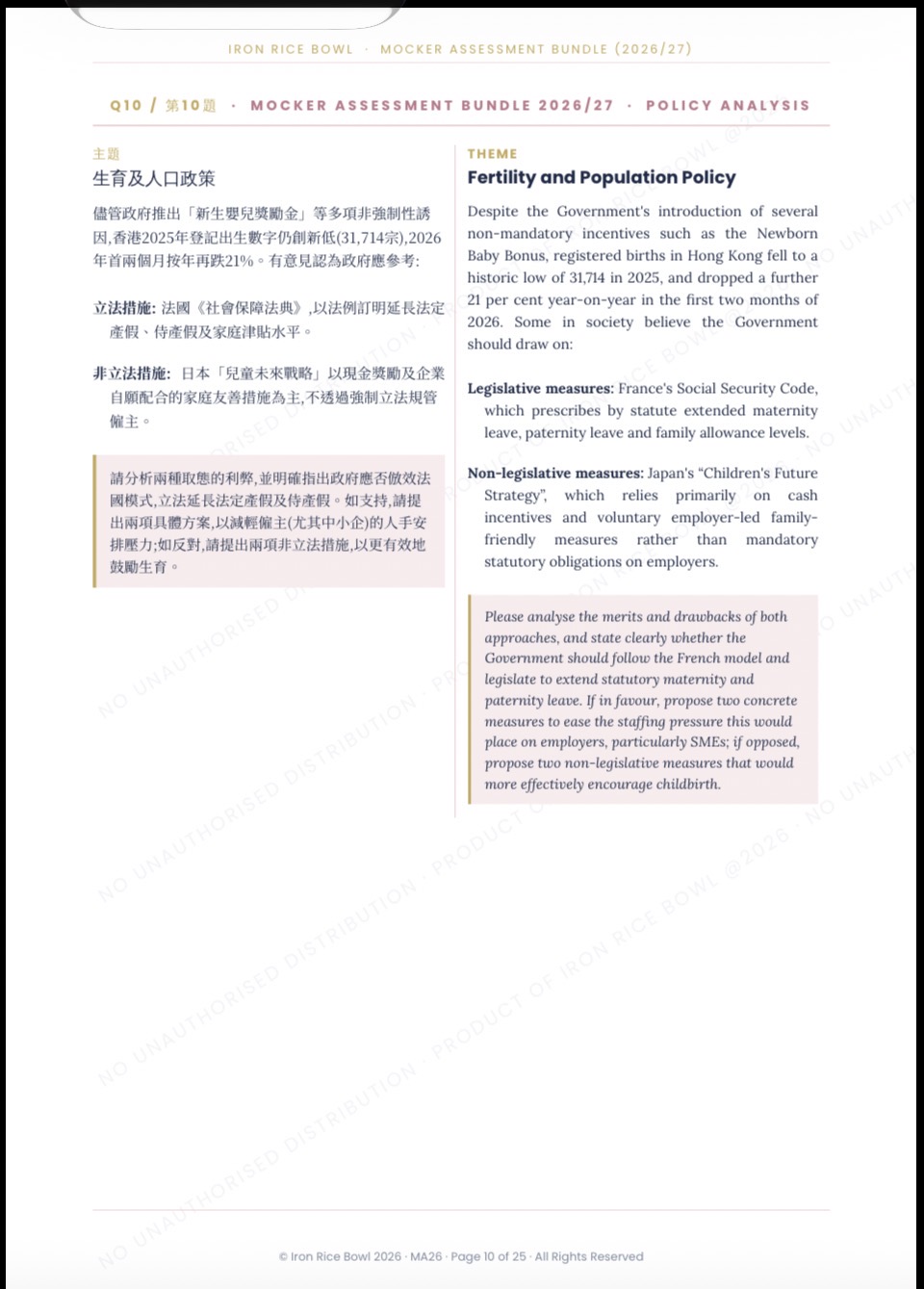
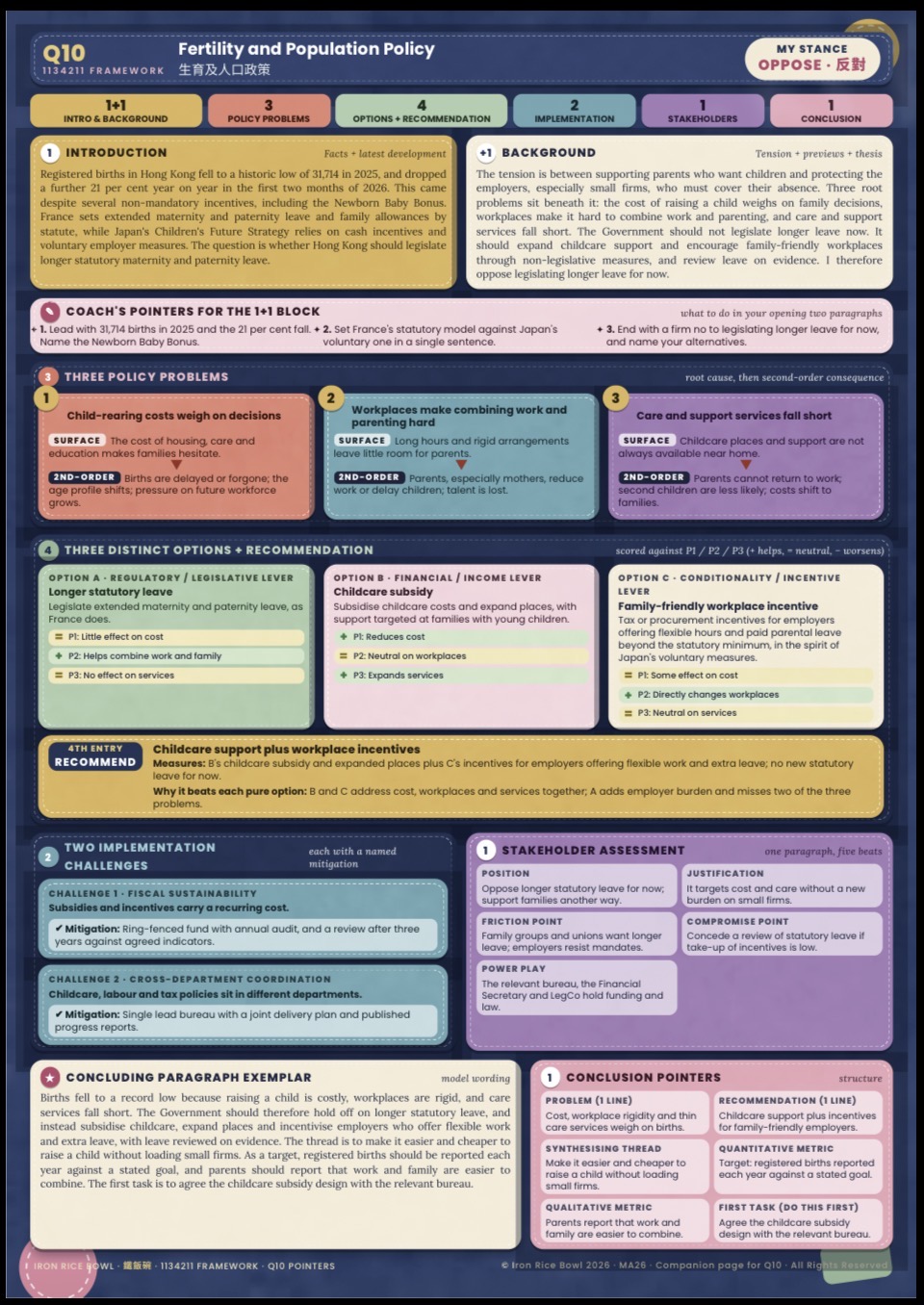
| MA-06 | Birth rate and population policyOpened below |
| MA-07 | Labour importation and the talent pipeline |
| MA-08 | The wealth gap and targeted poverty alleviation |
| MA-09 | Tertiary education finance and research funding |
| MA-10 | The cultural and heritage tourism economy |
| MA-11 | Sports economy and the mega-event strategy |
| MA-12 | Municipal solid waste charging |
| MA-13 | Energy transition and the climate action plan |
| MA-14 | Digital government and smart city services |
| MA-15 | The startup ecosystem, I&T and re-industrialisation |
| MA-16 | Elderly employment and the retirement age |
| MA-17 | Mental health services and student wellbeing |
| MA-18 | Aviation hub strategy and the three-runway economics |
| MA-19 | Stablecoins, fintech and virtual asset regulation |
| MA-20 | Port competitiveness and maritime logistics |
| MA-21 | The New Capital Investment Entrant Scheme and family offices |
| MA-22 | District administration reform |
| MA-23 | Anti-scam and cyber fraud legislation |
| MA-24 | Railway expansion and integrated transport planning |
| MA-25 | Fiscal consolidation and public finance sustainability |
One question, opened. Judge the work.
Fertility and population policy. The question as the paper sets it, and the page that goes with it. Every question in the set comes with the same.
One Commitment. One Set.
25 Papers with Insights and Skeleton.
- 25 quality JRE assessment questions — the 2026 public policy matters
- The IRB Writing Skeleton
- Insights and Skeleton for every question
- Threshold Exemplars — Introduction and Conclusion only
- Access via the IRB Teachable Resources Portal
The terms.
- (a)Iron Rice Bowl has the final say in case of any dispute.
- (b)The 25 Questions will be made available on the IRB Teachable Resources Portal. Companions must register for a Teachable account to gain access to the Bundle materials.
- (c)Bundle materials will be released in 5 batches on 5 consecutive days, from 5 October 2026.
- (d)Iron Rice Bowl reserves the right to reclaim the difference in subscription fees in case of fraudulent, inaccurate or dishonest application of the Flash Codes.
The honest answers.
The clock knows. Be there when it starts.
The Flash Offer opens at 10:00 HKT · 1 October 2026 and runs for a limited window. Twenty-five questions. One paper. One price.
Back to the offer