


POLICY EXPRESS · PE-ENB-155 · Environment and Ecology Bureau
Climate Adaptation and Extreme-Weather Resilience
Records fell in 2025 and storms continued in 2026; the main drainage and coastal works finish only in 2030–2031.
Free. We only need your email. Unsubscribe at any time.
2 pages · English and 繁體中文 · Built on the 1134211 Framework · Facts as at 25 October 2026
Included in the Sprint Pass
This brief is part of the 186-brief library. Page 1 is shown free for five featured briefs only.
See the format in five free samples
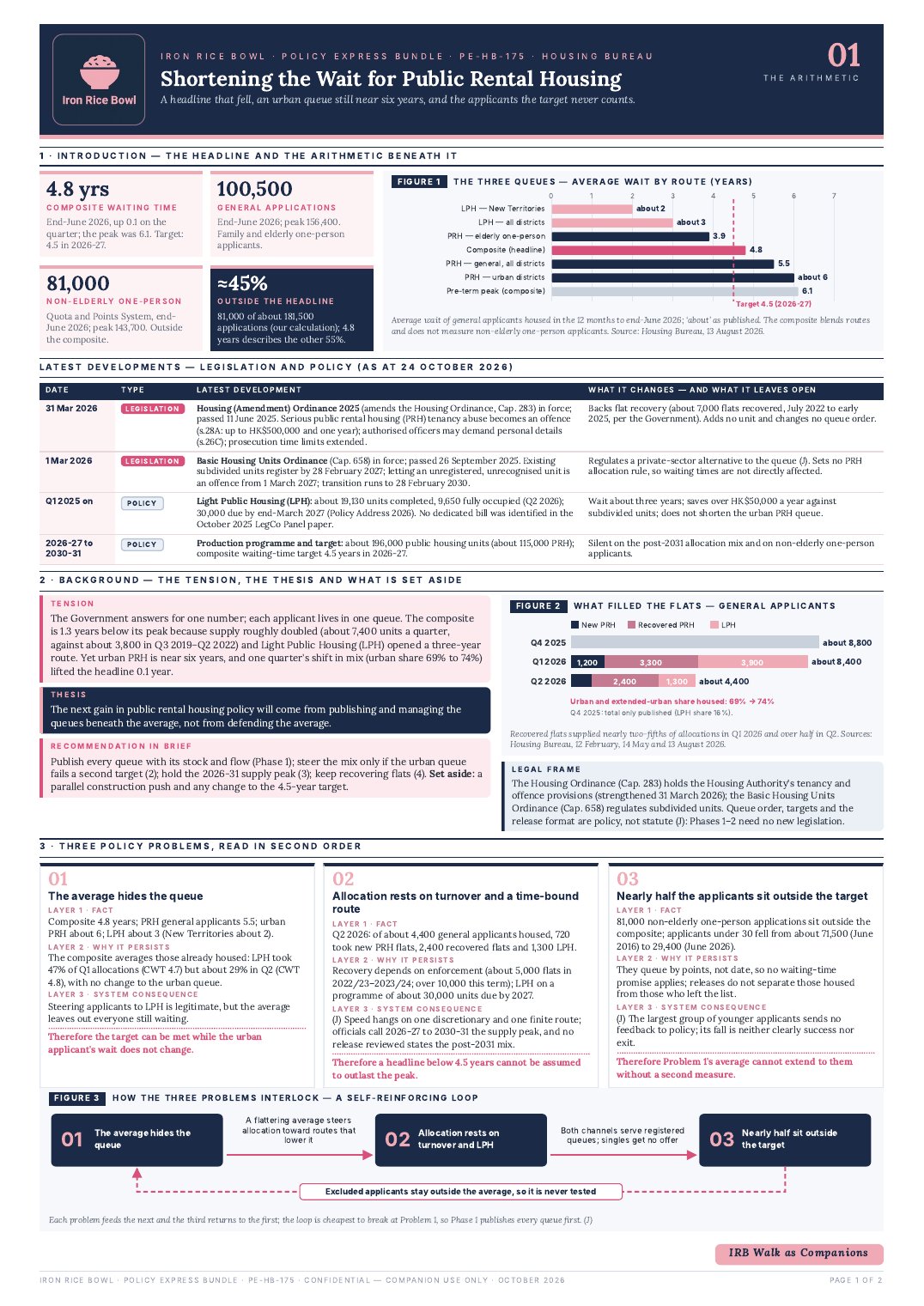
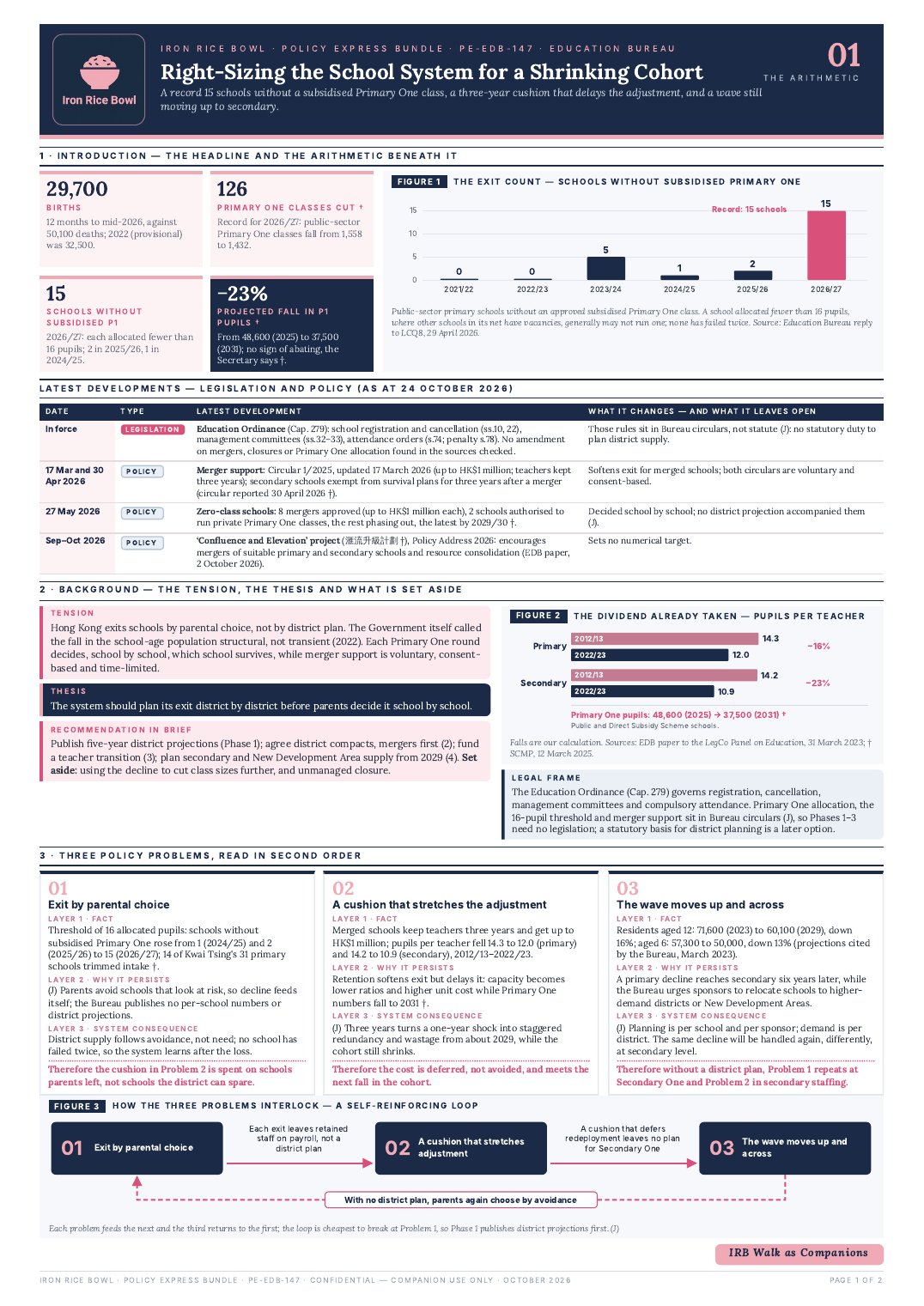
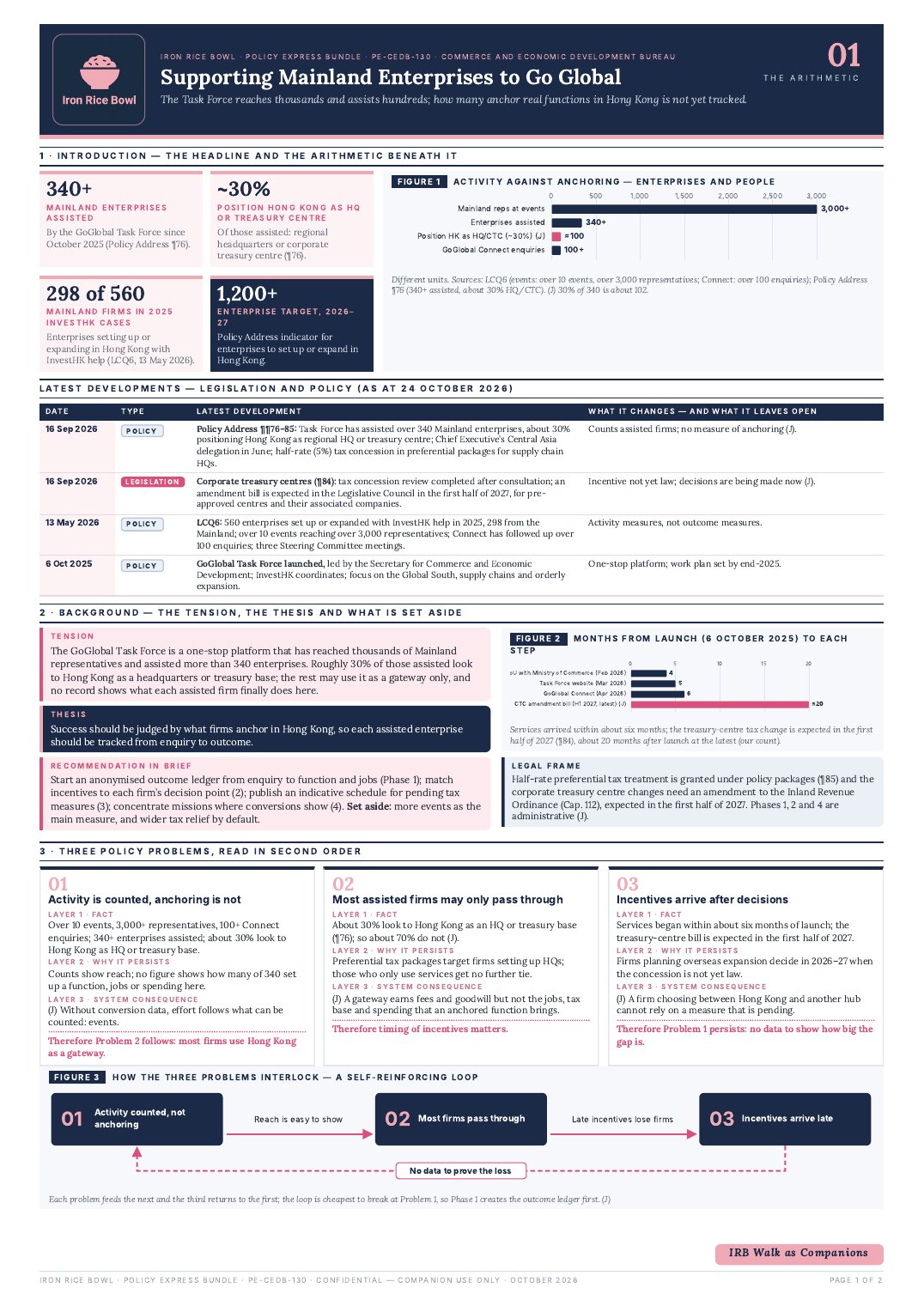
The tension and our thesis
The tension
Hazards are arriving faster than protection: the works that cut flood risk complete between 2030 and 2031, while warnings are being sharpened now and the financial cushion is still being designed.
Our thesis
Close the gap between hazard and protection with a published risk-ranked works schedule, warnings tied to action, and a protection-gap measure.
Three policy problems this brief examines
- 01Hazards arrive faster than protection
- 02Warnings improve, hotspots persist
- 03Financial cover is still being designed
Each problem is developed in three layers: the fact, why it persists, and the consequence for the system.
Three options compared
A · Crash programme: finish all drainage and coastal works early.
B · Warning-led: AI warnings, drones and emergency centre; works as scheduled.
C · Cover-led: climate insurance and household protection scheme.
The scored comparison, the justified recommendation with its phased measures, the implementation challenges, the stakeholder assessment and the success metrics are in the full brief.
Page 1 of this brief is not offered as a free sample.
See what is in the full briefWhat the Sprint Pass opens for this brief
Both pages, in English and Traditional Chinese: the introduction and background, key figures, the three policy problems, the scored options, the recommendation with its phased measures, the implementation challenges, the stakeholder assessment and the conclusion.
How Companions use it
Learn the structure.
Every brief follows the same 1134211 Framework, so you can rehearse the same shape of answer on any topic.
Borrow the facts.
The key figures and the latest developments are laid out so you can cite them with confidence and check them before you do.
Test your own view.
Form your recommendation first, then compare it with ours.
Briefs support your preparation. They do not guarantee any examination or interview result.
Facts and figures are checked against primary sources where we could retrieve them. † marks press-only figures. (J) marks IRB judgements. Facts as at 25 Oct 2026.
Questions
More briefs from Environment and Ecology Bureau
PE-ENB-152
Climate Action Plan 2050 and Decarbonising the Grid
PE-ENB-153
Municipal Solid Waste Charging and the Circular Economy
PE-ENB-154
Green Fuels: Sustainable Aviation Fuel and Green Hydrogen
PE-ENB-156
Nature Conservation and Biodiversity
Preparing for 5 December 2026? Get all 186 briefs with the Sprint Pass.
See the Sprint PassIron Rice Bowl is an independent coaching provider. It is not part of, endorsed by or affiliated with the Hong Kong SAR Government. Briefs are study aids; facts are as at the date shown and should be checked against the latest official source before use.