



Hong Kong's Triple Whammy: Why Welfare Alone Won't Save the City's Workforce
A shrinking birth rate, a rapidly ageing population, and a job market being reshaped by AI. Hong Kong is being squeezed from three sides at once — and cash incentives alone will not change it.
At a Glance
- Hong Kong recorded just 29,700 births between mid-2025 and mid-2026 — the lowest since records began in 1962.
- The labour force shrank from 3.81 million in 2025 to 3.79 million between May and July 2026.
- Youth unemployment hit 14.6% for ages 15–19 and 8.4% for ages 20–29, partly because AI is replacing junior roles.
- Women's labour force participation sits at 47.3%; for those aged 60 and above, just 22.7%.
- Over 462,000 talent admission applications have been approved since 2023, with 73% from mainland China — but imported labour schemes are drawing serious criticism.
The Numbers Behind the Crisis
Hong Kong is being squeezed from three sides at once: a shrinking birth rate, a rapidly ageing population, and a job market being reshaped by AI. Financial incentives have been tried. They haven't worked. What the city actually needs is a structural rethink of who works, how they're supported, and what industries exist to employ them.
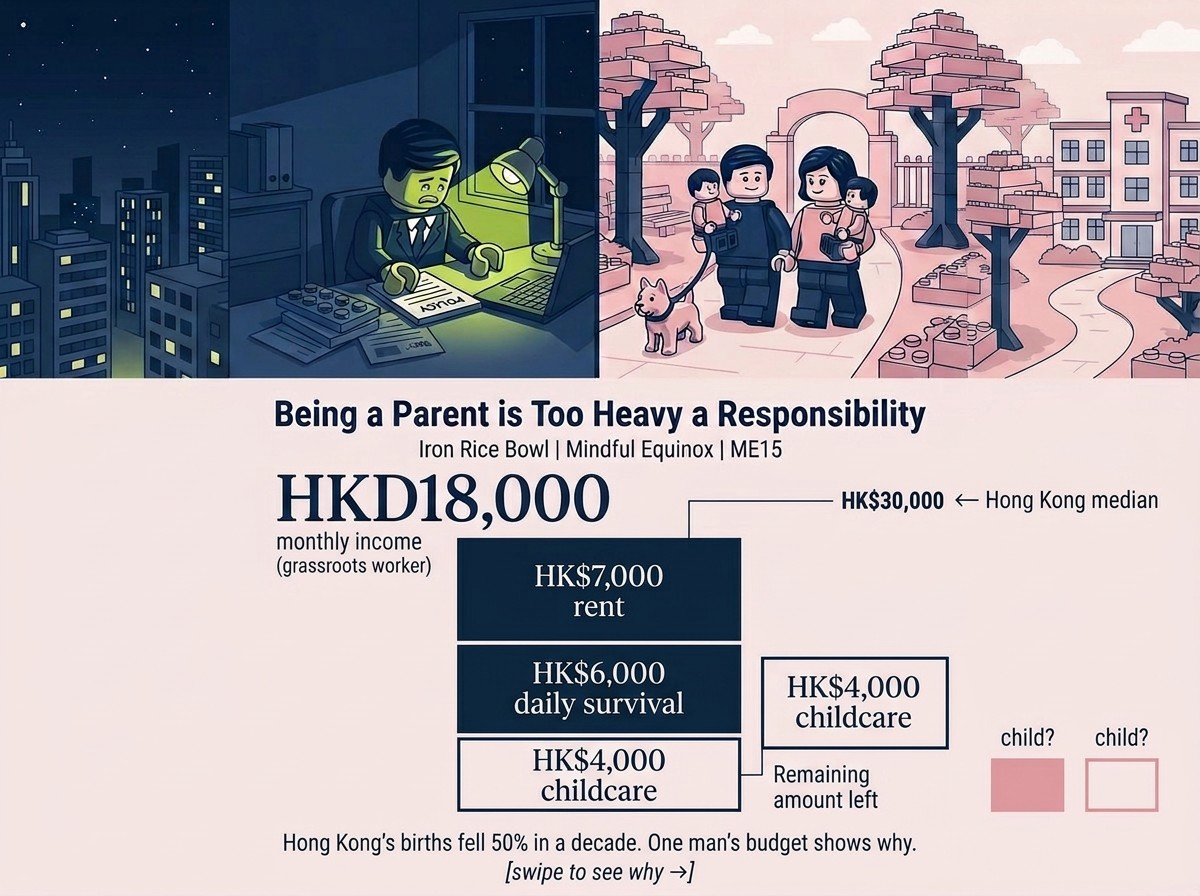
Take a typical scenario in Hong Kong's construction sector. A worker in his late twenties brings home roughly HK$18,000 a month and spends close to a third of that on a subdivided flat barely large enough to turn around in. He and his wife have run the numbers on starting a family. The arithmetic keeps producing the same answer.
That profile is common across Hong Kong's lower-income workforce, and it goes a long way towards explaining why birth figures have fallen to their lowest level in over six decades of recorded data.
29,700 births recorded between mid-2025 and mid-2026. In a city of 7.5 million.
The government has responded with the tools it knows: a one-off birth payment, tax concessions, preferential public housing access. Participation rates have barely shifted. Demographers and policy analysts consistently point to the same explanation: monetary transfers treat the surface of the problem. The structure underneath remains intact.
When housing costs swallow a third of a modest salary before a single nappy is purchased, a one-off cash payment doesn't change a family's calculation.
What Is the Triple Whammy?
Hong Kong's demographic pressure comes from three directions simultaneously.
1 · A Falling Birth Rate
The city's fertility rate has been declining for years. Financial pressure, cramped housing, and anxiety about education costs are the most commonly cited reasons. The 2025–2026 birth figures confirm the slide is continuing.
2 · A Rapidly Ageing Population
As fewer children are born, the proportion of elderly residents grows. The result is a high age dependency ratio: a shrinking working-age population carrying a larger burden of those who are no longer working. This creates fiscal strain that compounds over time.
3 · A Shifting Job Market
AI is already replacing junior positions across multiple sectors. Youth unemployment at 14.6% for the 15–19 age group is partly a direct consequence. The jobs that used to absorb school leavers are contracting, and the roles that AI will eventually generate require skills that school leavers don't yet have. That transition period is where the damage is accumulating, and it's happening now, not in some projected future.
Each of these three forces creates pressure on its own. Together, they compound in ways that incremental policy adjustments are unlikely to resolve.
Why the Current Approach Is Falling Short
Experts point to Singapore as a useful comparison. Singapore's pro-family measures offer nearly S$70,000 per child. Even that hasn't reversed the birth rate trend in any sustained way. Cash transfers, without broader structural support, tend to produce short-term upticks at best.
There's also a class dimension worth naming. Financial incentives carry more weight for working-class households facing genuine affordability constraints. For higher-income households, the decision involves different considerations entirely, and money tends to be a smaller part of them.
A comprehensive population policy, experts argue, needs to address housing, childcare, workplace flexibility, and genuine economic opportunity. Cash at the point of birth is the smallest piece of it.
Singapore spends nearly S$70,000 per child in pro-family support and still faces the same structural birth rate problem. Financial generosity alone hasn't been enough anywhere that's tried it.
How Imported Labour Fills the Shortfall — and Where It Creates New Problems
Since 2023, the government has approved over 462,000 applications through its various talent attraction programmes. Mainland Chinese applicants account for 73% of that total. Labour importation schemes have added a further 122,000-plus approved applications to the picture. Hong Kong has an advantage that other low-fertility cities lack: proximity to a large mainland population with existing cultural and linguistic ties.
The pushback is real too.
Critics of the Enhanced Supplementary Labour Scheme argue that, while the policy requires a two-to-one local-to-imported worker ratio and prior local recruitment efforts, the absence of industry-specific caps creates room for employers to quietly reduce local staff hours and salaries without technically breaching requirements.
Proposed reforms include setting sector-specific quotas and suspending applications in industries where local unemployment exceeds 4%.
Imported labour addresses short-term workforce numbers but doesn't resolve the underlying participation problem among local residents, particularly women and older workers.
The AI Disruption That's Already Here
Companies are replacing junior roles with AI tools right now. The 14.6% unemployment rate among 15–19-year-olds reflects, at least in part, the contraction of entry-level positions that would previously have absorbed school leavers.
New roles are emerging in AI compliance, regulatory oversight, and advanced device maintenance. Those roles require skills that most displaced workers don't currently hold, and closing that skills distance takes time that the labour market isn't waiting for.
Without deliberate upskilling programmes built around actual industry shifts, a generation of young workers risks being left behind in a labour market that has moved faster than the education system has adapted. Nobody has a clean answer for how long that transition takes.
Experts are calling on the government to develop courses grounded in real technological impact: AI literacy, professional knowledge, and interdisciplinary skills that span sectors.
AI will create jobs. The workers losing jobs to AI today aren't automatically positioned to fill the roles that emerge. Structured upskilling is the only realistic path through the transition.
Who Is Being Left Out of the Workforce
Two groups stand out as significantly underutilised.
Women
The labour force participation rate for women (excluding foreign domestic helpers) sits at 47.3%. Caregiving responsibilities are a primary barrier. More public childcare provision, especially for children under three, and flexible working arrangements with extended parental leave are among the most frequently cited solutions.
Single parents represent a particular pressure point. Extra subsidies to support course enrolment and strengthened childcare infrastructure would create a practical pathway back into employment for a group currently stretched on multiple fronts.
Older Workers
For those aged 60 and above, the participation rate is 22.7%. Current incentive schemes lean on short-term allowances, which experts describe as having limited sustained effect. A longer-term strategy combining financial support, skills training, and network-building is needed to make continued or returning employment a realistic option.
Raising the retirement age is part of this conversation, though it remains politically sensitive. Setting measurable targets for participation rates among both women and older workers is one concrete step experts are recommending.
Raising participation rates among women and older workers would add real capacity to the labour force without requiring additional importation schemes.
What a Holistic Strategy Actually Looks Like
Analysts argue welfare needs to sit inside a broader structural framework, not substitute for one. Based on the available expert commentary, a genuinely comprehensive approach would need to bring together:
- Job creation in emerging sectors, leveraging AI, green industries, and professional services to generate roles that match the city's evolving workforce profile.
- Upskilling infrastructure — government-funded courses built around actual technological displacement, not generic retraining programmes.
- Childcare expansion, particularly for the under-threes, where provision is currently most limited.
- Flexible work frameworks, enabling women and older workers to participate without requiring full-time, traditional employment arrangements.
- Targeted immigration policy — talent attraction that complements local workforce development rather than substituting for it.
- Labour importation reform — sector-specific caps and unemployment-linked suspension mechanisms to protect local low-income workers.
Each of these elements exists in some form within current policy. The ask is to deploy them with greater coherence and measurable accountability, not to invent new tools from scratch.
What This Means for the Policy Address
Chief Executive John Lee Ka-chiu's upcoming policy address is expected to address livelihood concerns. Given the demographic data now on the table, another round of cash payments and housing incentives won't read as a serious response.
What observers are reading for is evidence of joined-up thinking: a government that treats birth rates, workforce participation, and AI disruption as connected problems requiring connected solutions. Separate announcements from separate bureaux don't constitute that.
Hong Kong holds real structural advantages over comparable low-fertility cities: proximity to mainland China, a functioning talent admission infrastructure, and fiscal capacity even under constraint. Whether those advantages get deployed with the coordination and long-term intent the scale of this problem demands is the open question.
The policy address is an opportunity to signal genuine structural intent. Experts and residents will both be reading it for exactly that signal.
Frequently Asked Questions
Why is Hong Kong's birth rate so low?
High housing costs, financial strain, and concerns about education access sit at the top of the list. For lower-income workers in sectors like construction, the arithmetic of raising a child in Hong Kong keeps producing the same answer. The numbers don't work.
Has the HK$20,000 baby bonus made any difference?
Not in any measurable way. Experts consistently note that one-off financial incentives address the symptom rather than the structural causes. Singapore offers nearly S$70,000 per child in support and faces the same underlying trend.
What is the age dependency ratio and why does it matter?
The age dependency ratio measures the proportion of non-working residents (elderly and very young) relative to the working-age population. As fewer children are born and more residents age out of the workforce, a smaller group of workers is expected to sustain a larger dependent population. This creates fiscal pressure that intensifies over time.
How is AI affecting Hong Kong's youth unemployment?
Automation is contracting entry-level and junior positions across industries. Youth unemployment figures reflect this directly: 14.6% for the 15–19 cohort, 8.4% for 20–29-year-olds. The roles AI is expected to open up in compliance, regulation, and advanced technical maintenance require preparation that most displaced workers currently don't have, and acquiring it takes longer than a short retraining course.
Is imported labour the answer to Hong Kong's workforce shortfall?
Imported labour addresses immediate shortfalls but does not resolve the underlying participation problem. Critics argue current schemes lack sufficient protections for local low-income workers. Sector-specific caps and unemployment-linked suspension triggers are among the reforms being proposed.
What can be done to get more women into the workforce?
Expanding public childcare provision, especially for children under three where availability is most limited, is consistently cited as the most direct lever. Flexible working arrangements, longer parental leave, and targeted subsidies for single parents pursuing further training would extend that foundation.
What happens to older workers under the current system?
The participation rate for workers aged 60 and above sits at 22.7%. Short-term allowances, which make up the bulk of current incentive schemes for this group, haven't produced lasting change. Analysts point to a longer-term model combining financial support with skills development and access to professional networks, creating conditions for sustained participation rather than short-term uptake.
What should the upcoming policy address include?
The strongest signal would be evidence of joined-up thinking: job creation in growing sectors, upskilling tied to actual technological displacement, expanded childcare, reformed labour importation rules, and measurable targets for participation among women and older workers. Individual announcements matter less than whether they fit together into a coherent whole.
Key Takeaways
- Hong Kong recorded just 29,700 births in 2025–2026, the lowest since 1962. The slide is continuing.
- Financial incentives alone haven't reversed the birth rate trend, and the evidence from Singapore suggests more money is unlikely to change that on its own.
- AI is already displacing junior workers. Youth unemployment at 14.6% for 15–19-year-olds is a current consequence, not a projected risk.
- Women and older workers are significantly underutilised. Raising their participation rates is one of the most achievable near-term levers available.
- Imported labour addresses short-term shortfalls but creates new pressure on local low-income workers without proper sector-specific protections.
- A coordinated strategy across childcare, upskilling, job creation, and immigration policy is what experts are asking for. Separate announcements don't add up to that.
- The upcoming policy address will show whether Hong Kong is ready to treat this as the structural problem it is.